
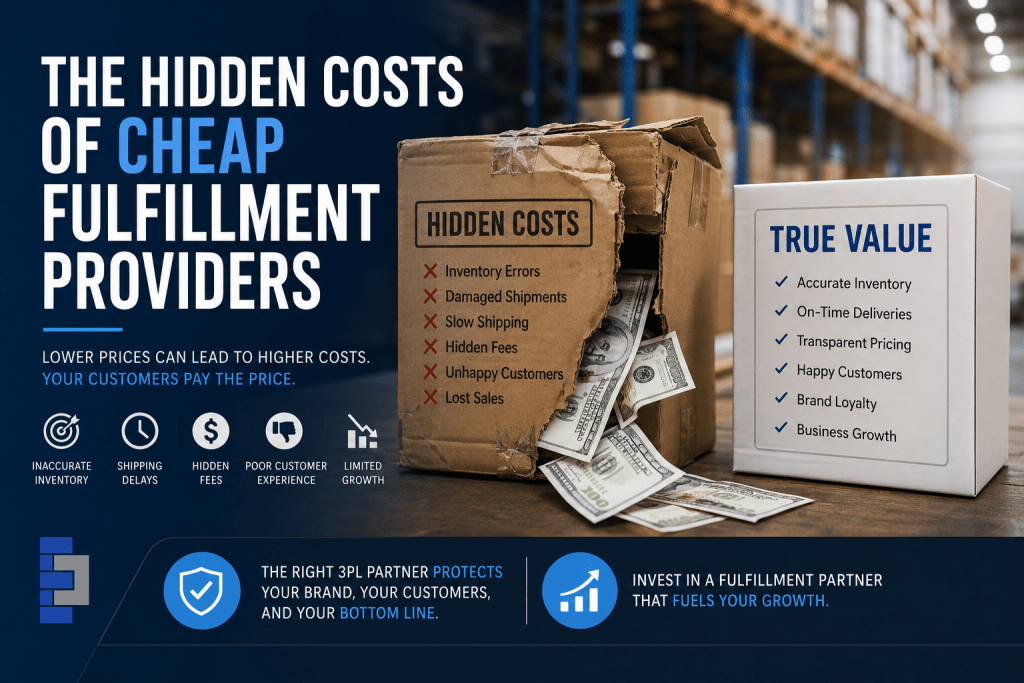
While low-cost fulfillment providers may appear attractive on paper, the hidden costs often outweigh the initial savings. Inventory inaccuracies, poor communication, shipping delays, and damaged customer relationships can quietly erode margins and limit growth.
For brands that prioritize customer experience, operational excellence, and long-term scalability, the cheapest option is rarely the best option.
Here’s what many growing brands discover after partnering with a low-cost 3PL.
1. Inventory Inaccuracies Can Cost Thousands
Inventory accuracy is the foundation of a successful fulfillment operation.
Unfortunately, many low-cost providers cut corners on:
- Cycle counting procedures
- Quality control processes
- Warehouse technology
- Employee training
The result?
- Oversold products
- Stockouts
- Backorders
- Lost inventory
- Emergency replenishment shipments
Even small discrepancies can create significant downstream costs.
For example, a brand that oversells inventory during a major promotion may face:
- Refunds and chargebacks
- Increased customer service costs
- Negative reviews
- Lost future sales
Premium fulfillment providers invest heavily in inventory controls because accuracy directly impacts customer satisfaction and profitability.
2. Poor Customer Experience Hurts Lifetime Value
Your customers don’t know—or care—which warehouse ships their orders.
They only know the experience they receive.
When a fulfillment provider ships the wrong product, sends damaged goods, or misses delivery expectations, your brand takes the blame.
Common issues with budget fulfillment providers include:
- Incorrect orders
- Damaged shipments
- Delayed processing times
- Inconsistent packaging
- Missed shipping SLAs
These mistakes often lead to:
- Increased support tickets
- Negative product reviews
- Lower repeat purchase rates
- Customer churn
In today’s competitive ecommerce environment, customer experience is a major differentiator. A single poor fulfillment experience can cost far more than a few dollars saved on pick-and-pack fees.
3. Hidden Fees Can Quickly Eliminate Any Savings
Low rates often come with hidden charges.
Some fulfillment providers advertise aggressive pricing only to offset those rates through accessorial fees such as:
- Receiving surcharges
- Additional handling fees
- Project fees
- Inventory adjustment fees
- Storage overage charges
- Special packaging fees
- Minimum monthly charges
Brands frequently discover that their actual monthly invoice is significantly higher than expected.
Transparent pricing should never be considered a luxury. Your 3PL should provide clear, predictable billing that allows you to accurately forecast costs as you scale.
4. Slow Communication Creates Expensive Problems
Operational issues are inevitable in fulfillment.
The difference is how quickly those issues are identified and resolved.
Many low-cost providers operate with lean support teams that struggle to keep pace as volume grows.
If your team routinely experiences:
- Delayed email responses
- Difficulty reaching account managers
- Lack of proactive communication
- Slow issue resolution
small problems can quickly become major disruptions.
A fulfillment partner should act as an extension of your operations team—not another problem to manage.
5. Operational Limitations Restrict Growth
As brands grow, fulfillment requirements often become more sophisticated.
You may need:
- Kitting and bundling
- Subscription box assembly
- Custom packaging
- Retail compliance services
- Amazon FBA preparation
- Multi-channel fulfillment support
Many low-cost fulfillment providers are designed for simple pick-and-pack operations and struggle to support more complex workflows.
Operational inflexibility can limit your ability to launch new products, run promotions, expand sales channels, or create differentiated customer experiences.
6. Peak Season Failures Are Extremely Costly
Peak season exposes weaknesses in warehouse operations faster than any other period.
Budget providers often lack:
- Adequate staffing
- Scalable processes
- Sufficient warehouse capacity
- Contingency planning
This can result in:
- Order backlogs
- Missed holiday deadlines
- Shipping delays
- SLA failures
For ecommerce brands, poor peak season execution doesn’t just impact short-term revenue—it can damage customer relationships that took years to build.
7. Switching 3PLs Is More Expensive Than Choosing the Right One Initially
One of the most overlooked costs of choosing a cheap fulfillment provider is the cost of eventually leaving.
Transitioning fulfillment operations requires:
- Inventory transfers
- System integrations
- Operational planning
- Customer communication
- Internal resources and time
Many brands that initially selected the lowest-cost provider ultimately switch within a year or two after experiencing operational challenges.
Choosing the right fulfillment partner from the beginning can prevent costly disruptions and position your business for long-term growth.
What Should Brands Look for Instead?
Rather than focusing solely on price, brands should evaluate potential 3PL partners based on:
✓ Inventory accuracy
✓ Communication and responsiveness
✓ Technology and visibility
✓ Scalability
✓ Operational flexibility
✓ Customer experience standards
✓ Pricing transparency
The right fulfillment partner should support growth, protect your brand reputation, and improve operational efficiency.
Final Thoughts
Price matters—but it should never be the only factor when selecting a fulfillment provider.
The true cost of fulfillment extends far beyond storage and pick fees. Inventory inaccuracies, poor communication, customer dissatisfaction, and operational limitations can have a significant impact on profitability and brand reputation.
For growing ecommerce brands, investing in a high-quality fulfillment partner is often one of the most important decisions they can make.
Because in fulfillment, the cheapest option is rarely the least expensive in the long run.